Connect approved context
Use relevant artifacts, relationships, standards, regulatory requirements, organisational guidelines and approved decisions.
KlugSpice uses governed, specialist AI agents to assist engineering teams across Automotive SPICE process areas.
Each workflow is configured with approved inputs, expected outcomes, responsible engineering roles and review conditions.
Use relevant artifacts, relationships, standards, regulatory requirements, organisational guidelines and approved decisions.
A specialist agent prepares a work-product proposal, quality finding, trace relationship, impact analysis or readiness observation.
The responsible engineer evaluates sources, assumptions, findings, relationships and technical rationale.
An authorized engineer accepts, revises, rejects or escalates the proposal.
Where supported and configured, approved outcomes return with provenance and review history preserved.
KlugSpice assists teams across Automotive SPICE process areas by preparing work products, analysing engineering relationships, identifying potential gaps and maintaining reviewable evidence.
Prepare requirement candidates and analyse ambiguity, inconsistency, duplication, completeness, feasibility, verifiability and missing parameters.
Prepare system and software architecture proposals, allocations, interfaces, design elements and supporting rationale.
Prepare verification criteria, test scenarios, test specifications, procedures and coverage observations.
Analyse relationships, propose missing links and maintain reviewable traceability across engineering work products.
Identify affected requirements, architecture, interfaces, components, tests, evidence, baselines and responsible roles.
Surface potential process-area gaps, missing evidence, incomplete reviews, traceability weaknesses and baseline issues.
KlugSpice prepares information, analyses engineering context and proposes reviewable outcomes. It does not replace the roles responsible for engineering decisions, quality assurance, process governance or assessment.
KlugSpice can be integrated with the requirements, ALM, PLM, test, code and delivery systems already used by an organisation. It does not require those systems to be replaced. Integration scope depends on the customer toolchain, available interfaces, permissions, required artifact types and the workflow being implemented.
Requirements, lifecycle, review, test and verification context.
Requirements, artifact relationships and lifecycle context.
Requirements, ALM, review and engineering workflow context.
Planning, issues, defects, changes and workflow information.
Work items, code, builds, tests and delivery information.
Product lifecycle, configuration and controlled engineering context.
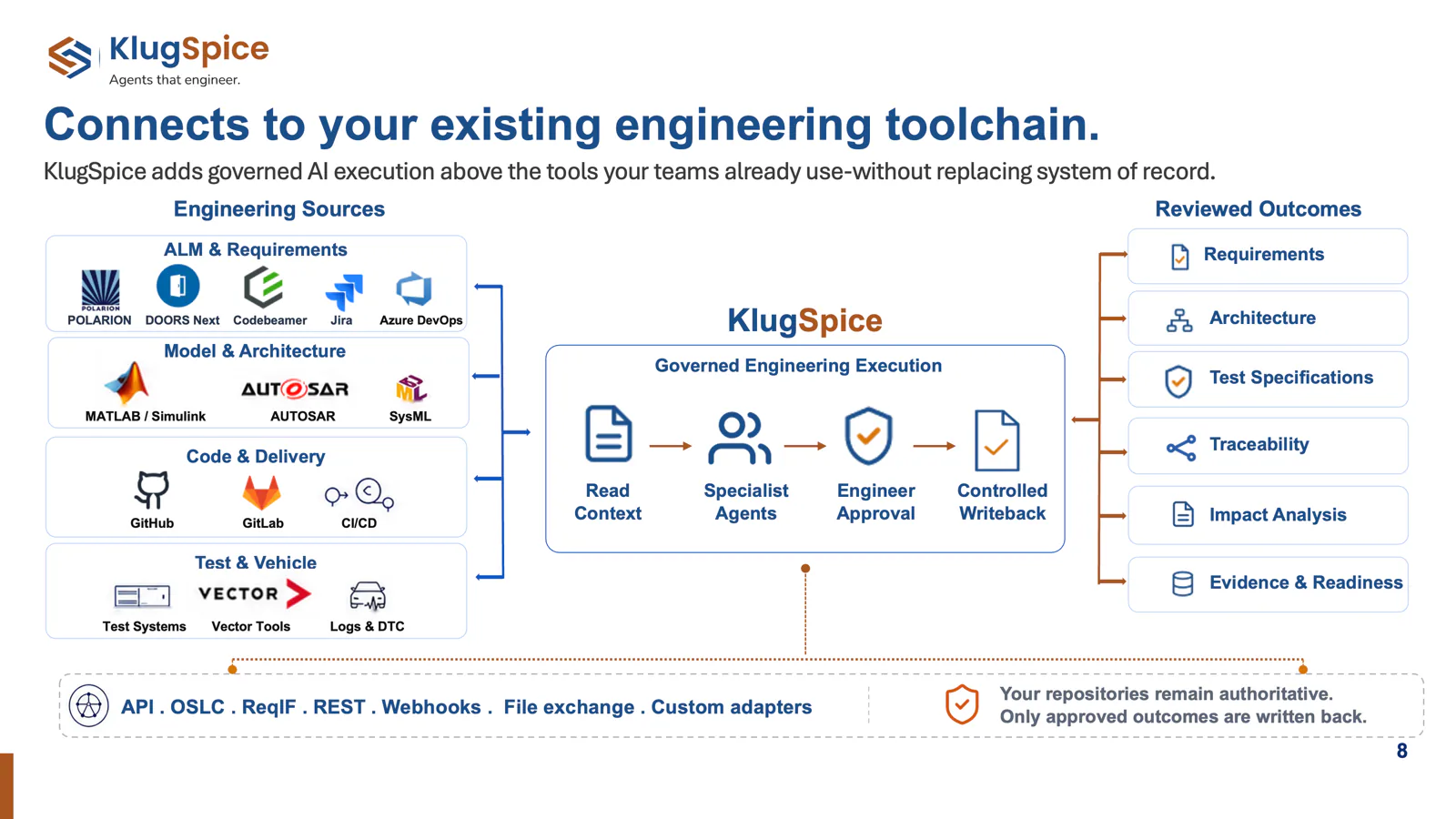
Product and company names identify potential integration targets. Their inclusion does not imply a commercial partnership, endorsement or certified connector unless explicitly stated.
The exact contribution depends on the organisation’s defined processes, performed engineering work, project scope and configured KlugSpice workflows.
| Process context | Potential KlugSpice contribution |
|---|---|
| Requirements-related processes | Requirement candidates, quality findings, stakeholder, system and software context, derivation and allocation relationships, reviews and lifecycle traceability. |
| Architecture and design processes | Architecture and design proposals, functional and technical allocations, interface information, design rationale and review evidence. |
| Verification and validation processes | Verification criteria, test scenarios and specifications, coverage analysis, requirement-to-test relationships, findings and result evidence. |
| Supporting processes | Quality findings, review status, configuration and baseline context, change requests, impact analysis, defect relationships and evidence preparation. |
| Management and organisational processes | Project decision context, responsibility and review information, readiness reporting, organisational guidelines, templates and reusable engineering knowledge. |
Scope note: This mapping identifies where KlugSpice may contribute to engineering activities and objective evidence. It does not demonstrate complete process coverage, achievement of process outcomes or an Automotive SPICE capability-level rating.
KlugSpice uses the approved engineering, process and compliance context relevant to the configured workflow.
Requirements, architecture, interfaces, design information, test specifications, results, defects, change requests and supporting documents.
Upstream and downstream traceability, allocations, dependencies, verification relationships and existing lifecycle links.
Applicable Automotive SPICE material, safety and cybersecurity standards, regulatory requirements and customer-specific obligations.
Internal processes, templates, quality criteria, naming conventions, review procedures, definition-of-done criteria and approval rules.
Approved decisions, assumptions, versions, releases, configuration status, baselines and previous review outcomes.
Expected outcome, responsible engineering roles, review conditions, approval authority and synchronization rules.
KlugSpice prepares reviewable engineering work products, analyses lifecycle relationships and maintains the information required to evaluate coverage, consistency, change impact and assessment readiness.
Requirements, architecture descriptions, interfaces, verification criteria, test specifications and other configured work products.
Potential ambiguity, inconsistency, duplication, incompleteness, unverifiable language, missing parameters and conflicts.
Proposed and reviewed relationships across stakeholder requirements, system requirements, architecture, software requirements, design and verification.
Work products without sufficient upstream or downstream relationships and verification items with unclear coverage.
Affected requirements, architecture, interfaces, components, tests, evidence, baselines and responsible roles.
Analysis of verification criteria and whether planned or completed verification work provides the intended coverage.
Outstanding findings, review completion, approval state, artifact versions, configuration status and baseline readiness.
Connections between performed engineering activities, approved work products, traceability, reviews, decisions and configuration status.
Potential process-area gaps, missing evidence, incomplete reviews, traceability weaknesses and baseline blockers.
Source artifacts, versions, assumptions, analysis results, reviewer identity, approval decisions and rationale.
No. KlugSpice coordinates governed engineering execution across existing requirements, ALM, PLM, test, code and delivery systems. These systems continue to hold authoritative project information.
For supported workflows where synchronization is enabled, approved outcomes can be returned to the appropriate controlled system.
No. KlugSpice supports engineering execution and assessment preparation by connecting work products, traceability, reviews, baselines, decisions and objective evidence.
A qualified assessor remains responsible for determining process-attribute ratings and the resulting capability level.
A general-purpose AI assistant can generate text from a prompt. KlugSpice is designed to support governed engineering execution using approved project context, configured workflows, specialist agents, lifecycle relationships and defined review authority.
The objective is not to generate more content. It is to prepare engineering outcomes that can be reviewed, understood, traced and controlled within established processes.
Clear answers for engineering, quality, security and programme leaders.
KlugSpice can assist activities and evidence preparation across Automotive SPICE process areas. Exact workflow coverage depends on the organisation’s processes, project scope, available context and configured capabilities.
No. KlugSpice prepares and analyses engineering outcomes. Authorized engineers remain responsible for review, acceptance, approval and release.
KlugSpice can analyse lifecycle relationships, identify potential gaps and propose trace links. Proposed relationships remain subject to engineering review and approval.
KlugSpice can identify related requirements, architecture, interfaces, components, tests, evidence, baselines and responsible roles that may be affected by a proposed change.
No. KlugSpice can be integrated with existing engineering systems while those systems remain authoritative. Available integration scope depends on the customer environment and implemented interfaces.
No. KlugSpice can assist with evidence analysis and readiness observations. A qualified assessor determines process-attribute ratings and capability levels.
Select a defined workflow, connect the relevant approved context and evaluate quality, effort, traceability, change-impact visibility and control.