Architecture disconnected from requirements
The problem compounds as variants, suppliers and releases increase.
Prepare system and software architecture views, allocations, interfaces and rationale from approved requirements and constraints.
The work crosses artifacts, tools, responsible roles and lifecycle stages. Automating one document does not maintain the surrounding engineering intent.
The problem compounds as variants, suppliers and releases increase.
Teams spend review time reconstructing context instead of evaluating the engineering decision.
Disconnected evidence makes change and assurance slower than the work itself.
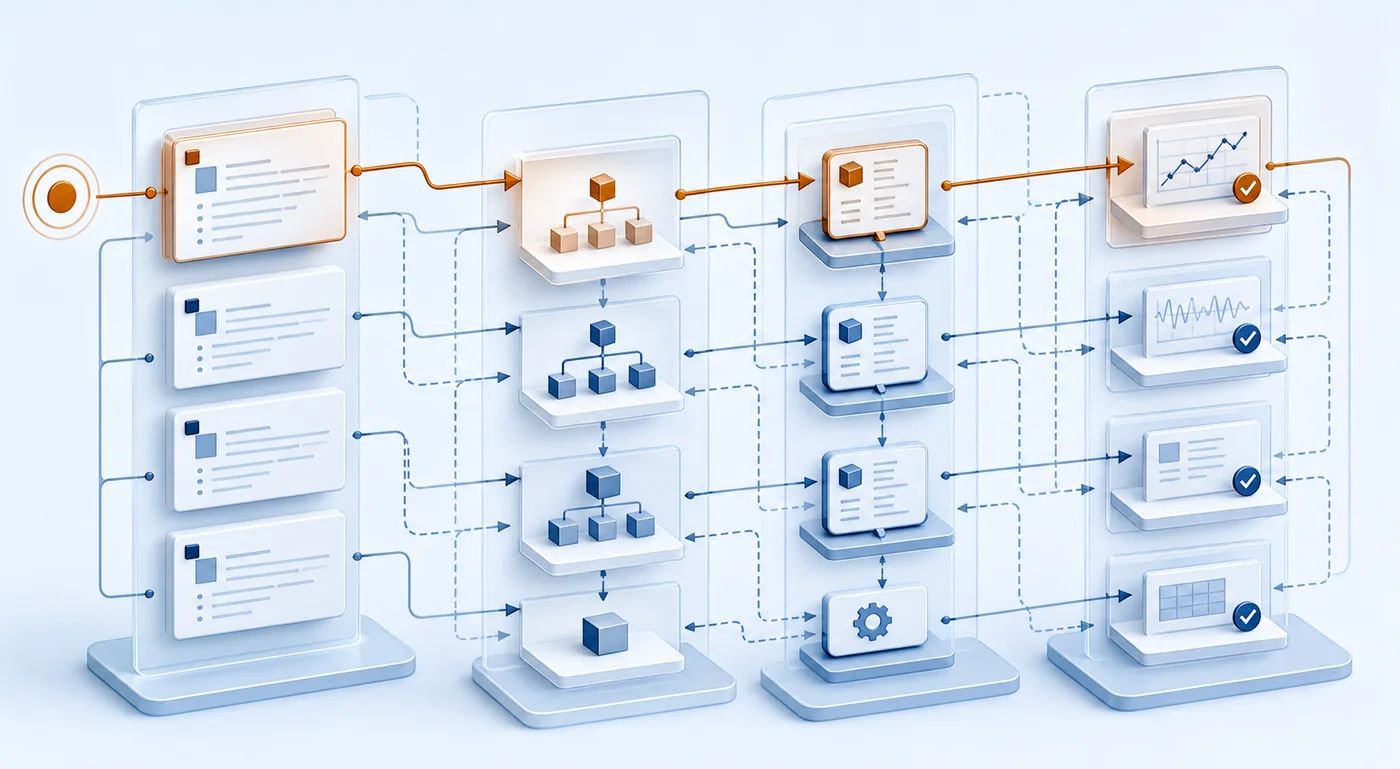
KlugSpice establishes a controlled loop between project truth, AI-assisted work, engineering review and system-of-record evidence.
Bring the relevant requirements, designs, standards, baselines and project decisions into a permission-aware engineering context.
A specialist agent analyzes or prepares a defined engineering outcome using only the approved context and rules for that task.
Engineers inspect sources, assumptions, relationships, quality checks and rationale before deciding what is acceptable.
Only authorized outputs move into controlled repositories, preserving provenance, review history and configuration status.
The workflow combines AI speed with the context, review and evidence controls expected from serious engineering.
Prepared from approved project sources with provenance visible to reviewers.
Analyzed against task-specific engineering and quality criteria.
Connected to relevant upstream and downstream artifacts.
Released only after the required human decision and configuration control.
Useful engineering automation starts with an explicit agreement about authority, scope and evidence. For ai-assisted architecture and design, the team should define these conditions as part of the workflow—not leave them inside an informal prompt.
Name the repositories, projects, baselines, artifact types and standards that may inform the task. Define how conflicts, obsolete versions and missing information are handled.
Specify the work-product structure, required relationships, terminology, quality criteria and evidence that make a proposal reviewable and useful.
Assign who can review technical correctness, who can approve release, and which findings require escalation or independent evaluation.
Determine what can be written back, to which system and lifecycle state, with the source references, rationale, reviewer identity and configuration history preserved.
A credible pilot compares a defined baseline with accepted outcomes. Raw token counts, documents generated or model confidence are not engineering success measures.
KlugSpice should reduce context reconstruction and repetitive preparation without blurring responsibility. The operating model makes contribution, review and release authority visible.
Receive source-linked proposals, quality observations and impact context. Engineers correct assumptions, make technical decisions and approve suitable outcomes.
Define process expectations and evidence criteria, evaluate gaps and review whether recorded execution demonstrates the intended control.
Control connector scope, field mapping, identities, permissions, failure handling and lifecycle states available for approved synchronization.
Prioritize valuable workflows, remove organizational constraints and evaluate quality, effort, coverage and risk without treating AI output volume as progress.
Every useful engineering output needs identity, source context, relationships, review state and configuration status. KlugSpice preserves that control chain instead of exporting disconnected AI text.
Move between the platform, engineering solution, industry and standard views without losing the engineering thread.
Clear answers for engineering, quality, security and programme leaders.
KlugSpice can accelerate analysis and preparation, but accountable engineers must review technical correctness, suitability, completeness and released evidence.
No. KlugSpice prepares, analyzes and proposes engineering work. Authorized engineers remain responsible for technical decisions, review, approval and released baselines.
No. KlugSpice is designed to connect controlled systems such as ALM, requirements, PLM, test and code repositories while those systems remain authoritative.
Yes. Deployment options include a customer VPC, on-premise and fully air-gapped operation with customer-controlled identity, repositories and model infrastructure.
Select a measurable engineering bottleneck, connect the approved context and compare reviewed outputs with the current method.