Automotive compliance engineering software

Governed AI for compliance-ready automotive engineering.

KlugSpice is an AI-native engineering execution platform for automotive programmes operating under Automotive SPICE, ISO 26262, ISO/SAE 21434 and applicable regulatory obligations.

Engineering responsibility

Compliance is an engineering outcome—not a software feature.

Automotive compliance cannot be achieved by installing a tool or generating a collection of documents. It depends on performed engineering work, competent decisions, controlled work products, maintained relationships, independent evaluation and evidence that remains consistent as the product changes.

  • Apply standards, regulations and organisational rules to defined engineering activities.
  • Prepare reviewable engineering work products.
  • Connect requirements, architecture, implementation and verification.
  • Identify traceability, consistency and coverage gaps.
  • Analyse engineering changes and maintain evidence readiness.
Framework distinctions

Which automotive frameworks can KlugSpice support?

Automotive programmes frequently operate under several connected frameworks. They address different engineering and regulatory concerns and must not be treated as interchangeable.

Automotive SPICE

Process assessment model

Evaluates the capability of development processes. KlugSpice can assist teams in preparing and connecting work products, reviews, traceability, baselines and objective evidence relevant to Automotive SPICE processes.

ISO 26262

Functional-safety standard

Defines a functional-safety lifecycle for road vehicles. KlugSpice can use approved safety information as governed context and connect relevant requirements, architecture, verification, change-impact information and evidence.

ISO/SAE 21434

Cybersecurity standard

Defines a cybersecurity-engineering lifecycle for road vehicles. KlugSpice can use approved cybersecurity information as governed context and connect requirements, engineering artifacts, verification, changes and evidence.

UN Regulation No. 155

Type-approval regulation

Establishes vehicle-cybersecurity and CSMS requirements for type approval. KlugSpice can support related evidence relationships in configured workflows; it does not determine whether a CSMS or vehicle type satisfies UN R155.

UN Regulation No. 156

Type-approval regulation

Establishes software-update and SUMS requirements. KlugSpice can support traceability, change impact, configuration context, verification evidence and approval history; it does not certify a SUMS.

Programme and organisational rules

Customer-defined execution

Approved customer processes, templates, quality criteria, terminology and review rules can be included in the governed context for configured workflows.

Scope: Availability and depth of support depend on the configured KlugSpice workflow, customer process, approved standards context, project information and implemented integrations.

Governed workflow

How does KlugSpice support compliance-ready engineering?

KlugSpice applies governed AI to defined engineering tasks instead of treating compliance as a standalone document-generation exercise.

01

Apply approved context

Use authorized artifacts, requirements, guidelines, decisions, templates and relationships.

02

Execute a specialist workflow

Prepare a defined engineering proposal, finding, relationship, impact analysis or readiness observation.

03

Present sources and rationale

Make relevant inputs, assumptions, relationships, findings and rationale available for review.

04

Review and decide

An authorized engineer accepts, revises, rejects or escalates the proposal.

05

Maintain controlled context

Where supported, approved outcomes return through the configured repository workflow.

A precise compliance boundary KlugSpice provides the execution framework and controls that support compliance-oriented engineering. It does not certify a vehicle, guarantee compliance or replace the engineers, assessors and authorities responsible for technical and regulatory decisions.
Engineering activities

Which engineering activities can KlugSpice assist?

KlugSpice connects compliance context to performed engineering work across the development lifecycle.

Requirements engineering

Prepare and analyse requirements using approved stakeholder, system, software, safety, cybersecurity, regulatory and organisational context.

Architecture and design

Prepare architecture and design proposals, allocations, interfaces and rationale for technical review.

Verification and validation

Prepare verification criteria, test scenarios, specifications and coverage observations from approved context.

Traceability and coverage

Analyse lifecycle relationships, propose missing links and identify orphaned artifacts or incomplete verification coverage.

Impact and change analysis

Identify requirements, architecture, interfaces, components, tests, evidence, baselines and roles potentially affected by change.

Evidence preparation

Connect performed work with work products, reviews, decisions, traceability, versions and configuration status.

Connected, not collapsed

How does KlugSpice connect process, safety and cybersecurity?

Automotive SPICE, functional safety and cybersecurity often depend on related product information. However, they have different objectives, work products, competent roles and acceptance criteria.

KlugSpice helps teams maintain explicit relationships between these domains without merging their responsibilities.

Process context

Performed practices, work products, reviews and objective evidence.

Safety context

Approved safety analyses, requirements, constraints and assurance evidence.

Cybersecurity context

Approved risk-analysis outputs, requirements, controls and supporting evidence.

Reviewed cross-references

Visible relationships with distinct artifact ownership and approval conditions.

End-to-end example

What happens when a braking-system requirement changes?

A single product change can affect process evidence, system and software engineering, functional safety, cybersecurity and verification.

  • 1. Identify potentially affected system and software requirements.
  • 2. Show related architecture elements and interfaces.
  • 3. Highlight connected safety and cybersecurity information.
  • 4. Identify verification assets and evidence requiring review.
  • 5. Prepare proposed work-product updates or traceability relationships.
  • 6. Present sources, assumptions and potential gaps to responsible engineers.
  • 7. Route approved outcomes through established change and configuration workflows.
Approved context

What project context can KlugSpice use?

KlugSpice uses approved engineering, process and compliance information relevant to a configured workflow.

Engineering artifacts

Requirements, architecture, interfaces, design, verification specifications, results, defects and change requests.

Lifecycle relationships

Derivation, allocation, dependency, implementation and verification relationships.

Standards and regulations

Applicable standards, regulatory requirements and customer-specific obligations.

Safety and cybersecurity context

Approved requirements, risk-analysis outputs, assumptions, constraints and engineering decisions.

Organisational guidelines

Internal processes, templates, terminology, quality criteria, reviews and approval rules.

Decisions and workflow controls

Approved decisions, baselines, expected outcomes, permitted actions, reviewers and synchronization rules.

Reviewable outcomes

What does KlugSpice produce?

KlugSpice prepares reviewable engineering outcomes and supporting information needed to evaluate consistency, relationships, impact and readiness.

Work-product proposals

Requirements, architecture descriptions, interfaces, verification criteria, test specifications and configured engineering artifacts.

Quality findings

Potential ambiguity, inconsistency, duplication, missing information, weak verification criteria and conflicts with project rules.

Traceability proposals

Reviewable upstream and downstream relationships between relevant engineering work products.

Coverage findings

Missing, incomplete, orphaned or inconsistent relationships across the lifecycle.

Impact information

Potential effects across artifacts, interfaces, tests, evidence, configurations, baselines and responsible roles.

Evidence-readiness findings

Missing evidence, incomplete reviews, traceability weaknesses and unresolved configuration issues.

Verification observations

Potential gaps between requirements, verification criteria, planned verification and available results.

Decision and provenance information

Relevant sources, versions, assumptions, analyses, reviewer identity and approval rationale according to the workflow.

Integration ecosystem

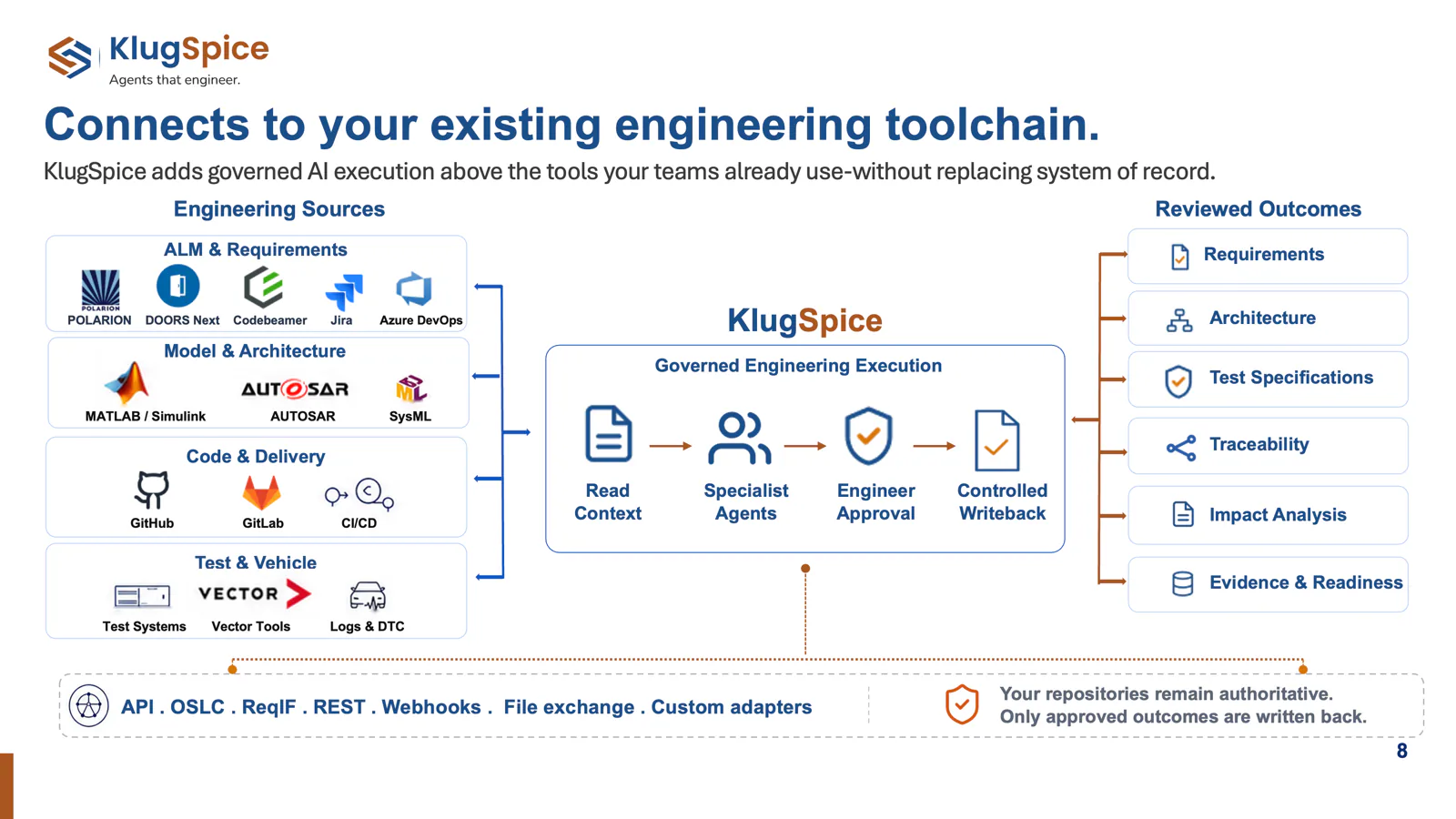
How does KlugSpice integrate with the existing engineering toolchain?

KlugSpice can be integrated with requirements, ALM, PLM, test, code and delivery systems used by the customer. Existing systems can remain authoritative for approved engineering information. Integration scope depends on the customer toolchain, available APIs, permissions, required artifact types, security requirements and implemented workflow.

Requirements and ALM

Potential targets include Polarion, IBM DOORS Next and Codebeamer.

Planning and delivery

Potential targets include Jira and Azure DevOps.

PLM and implementation

Potential targets include Teamcenter and relevant code, build and test environments.

KlugSpice connecting requirements, ALM, PLM, code and test systems to governed automotive engineering workflows
KlugSpice can connect the existing engineering toolchain to governed execution. Source systems remain authoritative, and synchronization depends on the configured integration and approval workflow.

References to named products identify potential integration targets. They do not imply a commercial partnership, endorsement or certified connector unless explicitly stated.
Clear product boundaries

What KlugSpice supports—and what remains with accountable authorities

Does KlugSpice make a product compliant?

No. It provides a governed framework for preparing, connecting, reviewing and maintaining engineering work and evidence. Compliance depends on applicable requirements, performed work, competent roles and the relevant approval procedure.

Is KlugSpice compliance software?

KlugSpice is best described as software for compliance-ready automotive engineering. It supports compliance-related workflows but is not a certification tool, approval authority or substitute for a compliant engineering organisation.

Does KlugSpice perform HARA or TARA?

KlugSpice can use approved HARA and TARA outputs as governed context and connect related safety and cybersecurity requirements with architecture, verification, change and evidence workflows. Exact functionality depends on the configured implementation.

Purpose-built execution

How is KlugSpice different from a general-purpose AI assistant?

General-purpose AI can draft content from a prompt. Compliance-ready engineering requires approved context, artifact identity, lifecycle relationships, named responsibility and controlled decisions.

KlugSpice is designed to prepare engineering outcomes that can be reviewed, understood, traced and controlled within established processes.

  • Approved engineering context
  • Specialist-agent tasks
  • Artifact identity and versions
  • Lifecycle relationships
  • Traceability and coverage
  • Impact and change analysis
  • Human review and approval
  • Evidence and provenance
  • Controlled integration
  • Customer-defined boundaries
Questions teams ask

Frequently asked questions

Clear answers for engineering, quality, security and programme leaders.

What is automotive compliance engineering software?

It helps teams apply standards, regulations and organisational processes to performed engineering work and supports the preparation, connection, review and maintenance of work products, traceability, decisions and evidence.

Does KlugSpice guarantee automotive compliance?

No. KlugSpice supports compliance-oriented engineering workflows but does not guarantee compliance, certification, assessment results or type approval.

Can KlugSpice certify ISO 26262 or ISO/SAE 21434 compliance?

No. KlugSpice can support preparation and connection of relevant engineering work and evidence. Certification and acceptance remain with the appropriate accountable and independent authorities.

Can KlugSpice make a project Automotive SPICE compliant?

No. It can support engineering execution, traceability and evidence preparation. Process capability is evaluated through an appropriate assessment based on performed work and objective evidence.

Does KlugSpice support UN R155 and UN R156?

KlugSpice can support configured workflows relevant to cybersecurity, software updates, traceability, change control and approval history. It does not certify a CSMS or SUMS and does not grant vehicle type approval.

Does KlugSpice perform HARA or TARA?

KlugSpice can use approved HARA and TARA outputs as governed engineering context and connect related safety and cybersecurity requirements with architecture, verification, change and evidence workflows. Exact functionality depends on the configured workflow and implementation.

Does KlugSpice replace existing ALM or requirements tools?

No. KlugSpice can be integrated with existing systems while those systems remain authoritative. Availability depends on the customer environment and implemented connector scope.

Can KlugSpice support change-impact analysis?

Yes. It can identify requirements, architecture elements, interfaces, verification assets, evidence, configurations and responsible roles potentially affected by a proposed change.

Can KlugSpice operate in a customer-controlled environment?

Deployment can be configured according to customer infrastructure, security, identity, model and data-boundary requirements. The applicable architecture must be agreed for the specific implementation.

Start with controlled scope

Evaluate KlugSpice on one compliance-relevant engineering workflow.

Select requirements quality, traceability, change-impact analysis or evidence readiness and evaluate the improvement in effort, consistency, visibility and control.